Organisational Design
-
How To Build A Bridge To A ‘Rogue Silo’ Team
In 1988 Phil. S. Ensor coined the term the functional silo system. His contention was that narrow, specialised teams and jobs were easy to manage, but imposed damaging learning disabilities on the organisation. As every function focuses on its own objectives and KPIs… Continue reading

-
Why Decentralised Place-Based Approaches Can Fail
Genuine place based decentralised approaches are not merely structural changes; they are assaults on the fundamental logic of the traditional organisation which is designed to minimise variance and maximise control. Continue reading

-
Are Small Companies Really Better At Innovation?
Large organisations kill innovation not by size, but by inertia. To avoid this, we must embrace organisational ambidexterity—balancing core efficiency (exploitation) with radical flexibility (exploration). That’s why I believe our model of place based working – the blueprint of which… Continue reading

-
The Way Out of The ‘Performance Myth’
The Performance Myth reduces individuals to commodities or “performers,” whose value is contingent on meeting predefined metrics. This leads to a workplace culture where employees are constantly evaluated not for their creativity, integrity, or contributions to collective well-being, but for… Continue reading

-
Transforming Public Services with Agile Principles
Applied outside of tech agile can usher in a fundamental shift from rigid, top-down planning to a dynamic, iterative, and, crucially, person-focused approach. Think about our place-based working experiments. What we understood, fundamentally, is that the answers to local problems… Continue reading

-
Can Institutions Decline Like Civilisations?
Many of our institutions are in decline. The average lifespan of a civilisation is 336 years, Big companies used to have a lifespan of 61 years, now it’s down to 18. If all civiisations fall. then surely so must all… Continue reading

-
The Small Challenge For Big Companies
Small = Optimised for Innovation Research suggests that smaller teams are more optimised for innovation. Indeed, as Dashun Wang and James A. Evans write for HBR, large teams can be better at development and deployment, but small teams are better at disruption. Their analysis… Continue reading

-
The Myth of Centralisation
The enemy of innovation is the management desire to centralise everything. Centralisation is often touted as being more efficient but it’s nothing of the sort. In truth it is a simply a corporate power grab, an attempt to control, to… Continue reading

-
The Desperate Need To Reorganise Our Resources
Brooks’ Law is a principle in software development that states: “Adding manpower to a late project makes it later.” It was coined by Fred Brooks in his 1975 book “The Mythical Man-Month” As more people join, the number of communication… Continue reading

-
Moving from ‘Decided Upon’ to ‘Decided With’
I’ve recently finished Dan Davies’ book The Unaccountability Machine: Why Big Systems Make Terrible Decisions. In it, he describes how systems have evolved to create “accountability sinks”: situations in which a human system delegates decision-making to a rule book rather… Continue reading

-
Relationships aren’t very efficient, but efficiency isn’t always effective
“CEO-ification” refers to the trend of nonprofits and charities to increasingly mirror corporate and military structures. Often they will adopt similar language, hierarchies, and strategic approaches. The trend began in the late 20th century, with a significant acceleration in the… Continue reading

-
Institutional ‘Forgetting’ and The Failure of Corporate Memory
Corporate amnesia or ‘institutional forgetting’ -is a phenomenon where organisations lose valuable knowledge, experience, and insights over time. This can be a gradual process or a sudden occurrence, and it can have significant negative impacts on an organisation’s performance, decision-making,… Continue reading

-
The Law of Propinquity And The Work From Home Dilemma
In our post-internet, post-social media, post-covid world, does physical proximity still have value, particularly when it comes to creativity, innovation and discovery? The law of propinquity states that the greater physical (or psychological) proximity between people, the greater the chance that they… Continue reading

-
The Growing Bureaucratisation Of Life
Many organisations , without realising it , act as inhibitors of creativity. Rules and protocols are put in place – often for very good reasons – that preserve the status quo. Over time, organisations develop a set of social norms – ‘the way we… Continue reading

-
Are You A Positive Deviant, A Negative Deviant, Or Just Plain Boring?
Even if your customer satisfaction scores are upper quartile. Even if you’re a favourite with your regulator. A crisis can be waiting around the corner for any organisation. You can’t regulate a toxic culture and you don’t build trust with… Continue reading

-
Autonomy Only Happens By Design
Most of us accept that bureaucracy squashes initiative, risk-taking, and creativity, but it doesn’t just stop there. Continue reading

-
The Case For An Organisational ‘Day Of Silence’
On Wednesday 22nd March I was back in lockdown, confined to a hotel room for 24 hours. Don’t feel sorry for me though, I was in Bali, Indonesia. On Nyepi day , which is New Year’s day in the Balinese… Continue reading

-
Understanding The System Beats Recruiting People Every Time
How much better off would we ALL be, if all the resources poured pointlessly into chasing talent were instead poured into understanding systems, and systems thinking? The Quintessential Group This week I got the opportunity to speak at the prestigious… Continue reading

-
If A Third Of What We Do Is Waste – Why Can’t We See It?
How do we create an environment where saying something is a waste of time is a good thing? Andy Tabberer There’s a fairly repeatable pattern in the behaviour of CEOs when they near retirement or leave the workforce entirely. They… Continue reading

-
Smaller, Flatter, Faster. Is The Two Pizza Team Finally Going Mainstream?
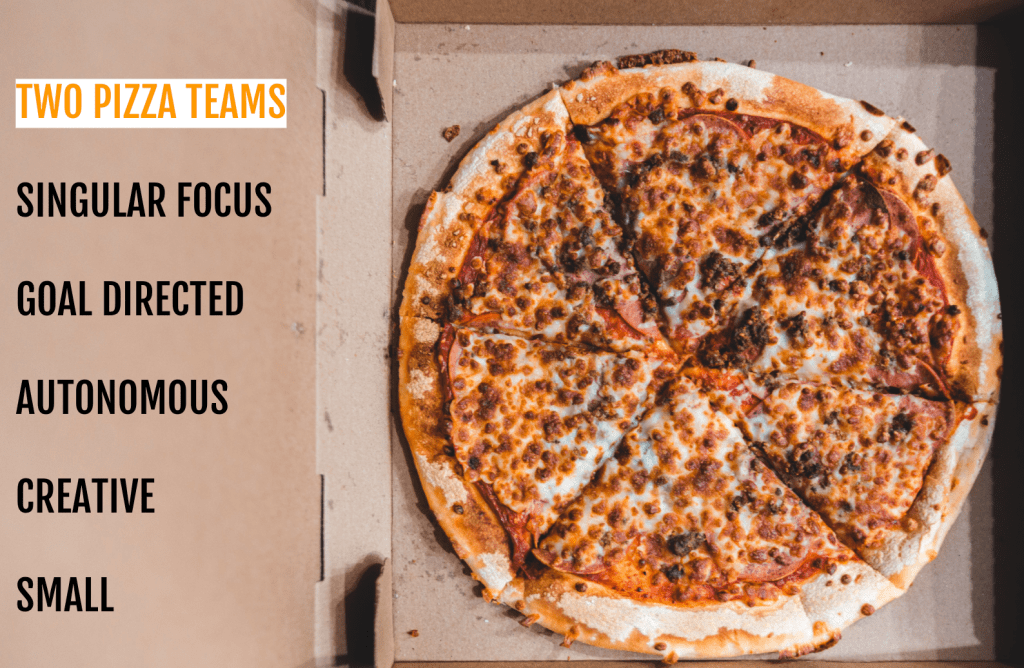
This weeks post looks at the two pizza team which was popularised by Jeff Bezos. In the early days of Amazon he instituted a rule that every internal team should be small enough that it could be fed with two… Continue reading
 Paul Taylor