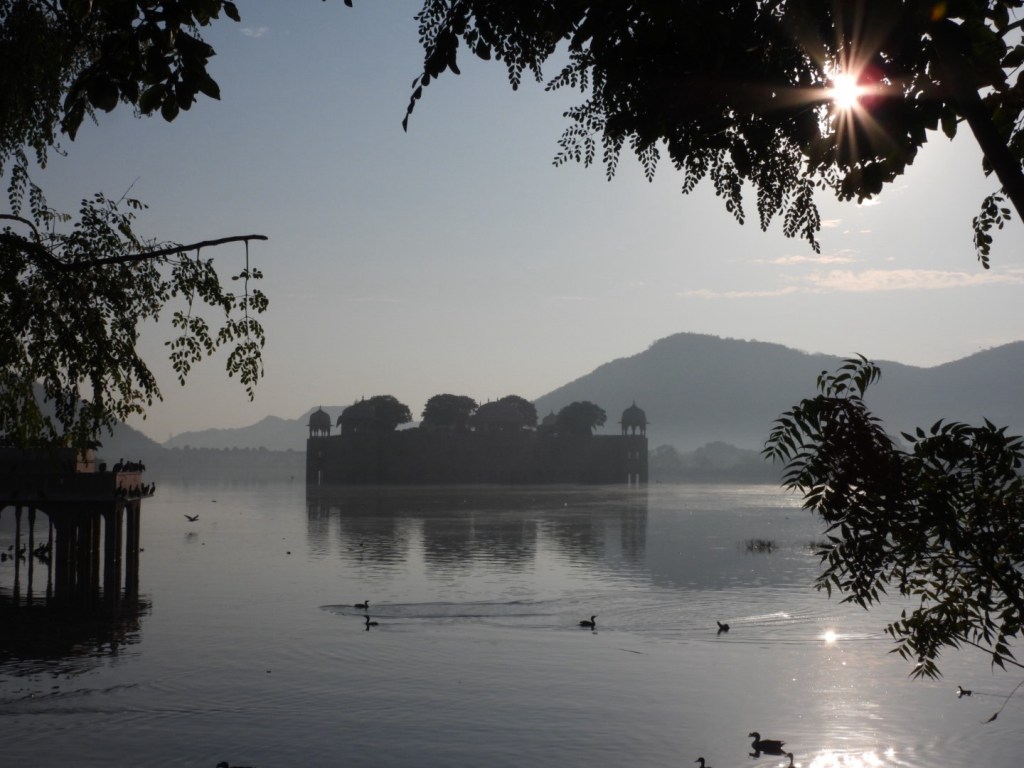
With a “Four a Day” picture diary the idea is to keep things simple and focused by capturing just four photos that define the day, each answering a specific prompt:
Where is it happening?
What are we doing?
Who is involved?
and Why?
It’s a way to cut through the noise of a busy trip without getting overwhelmed by a camera roll of hundreds of photos. By picking just four moments you can capture the essence of the experience with just a bit of commentary, leaving the rest for the memory bank.
I’ve not been great so far at one a day journalling. But I’m committing to it for the rest of the trip. And yes, I said that two posts ago.
Where is it happening?
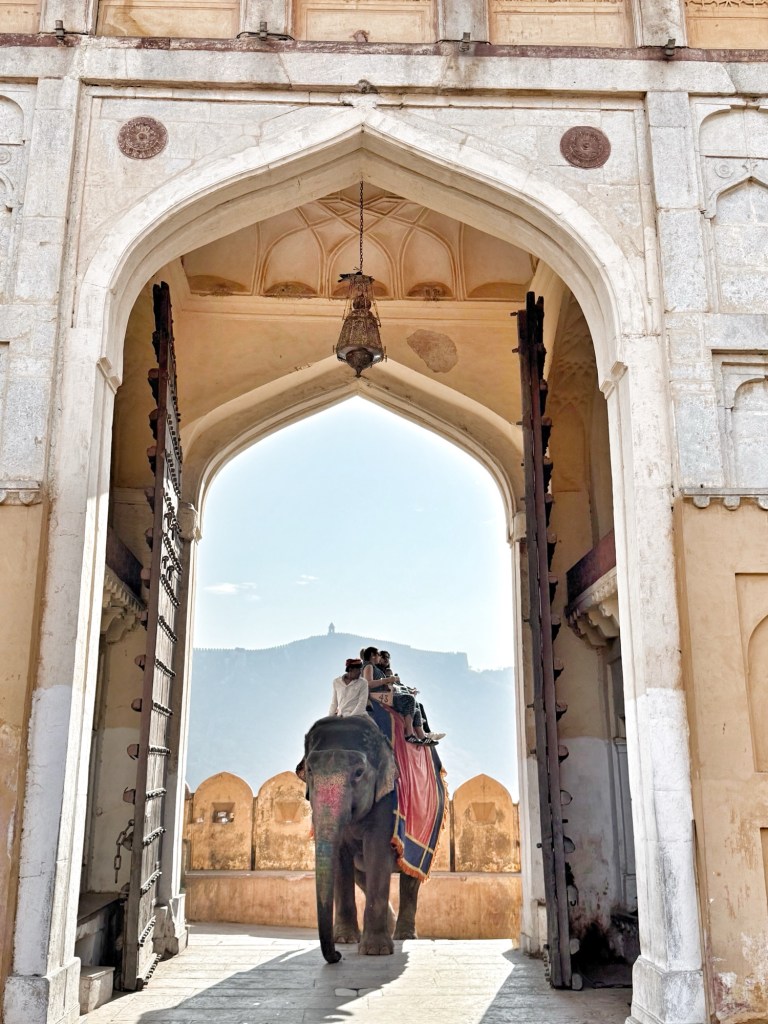
The Amber Palace – a hilltop fortress in Jaipur, India, blending Hindu and Mughal architecture through red sandstone and white marble.
I can’t even imagine how magnificent and alien this must have looked on construction over 400 years ago , devoid of traffic and tourists. But they didn’t have the luxury of an iPhone or Uber did they?
I don’t agree with the elephant riding by the way, but I still took a picture as they look undeniably majestic. To be fair, the elephants back in the day would have had to drag marble hundreds of miles to build these places, so I guess humping a few tourists around on their backs represents some kind of social progress.
What are we doing?
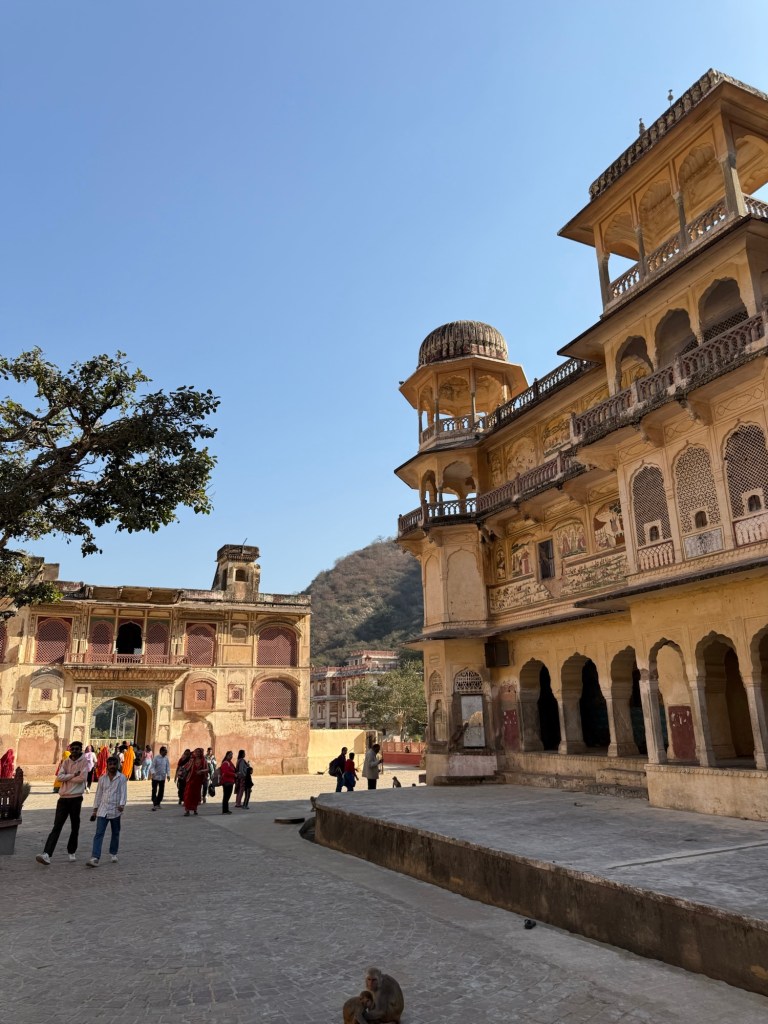
Visiting Galtaji which my driver pointed out, rather angrily , is not a “Monkey Temple” but is actually an ancient Hindu pilgrimage site nestled in a narrow mountain pass in the Aravalli Hills.
The site is named after Saint Galav, a revered Rishi who is said to have performed penance there for 100 years. According to legend, the gods were so pleased with his devotion that they blessed the area with a perennial spring, which today feeds the temple’s seven holy kunds.
The “Monkey Temple” moniker is a modern, colloquial name popularised by travellers and National Geographic documentaries (like Rebel Monkeys). It refers to the massive population (over 1000) of Rhesus macaques and Langurs that inhabit the abandoned and active temple structures.
Who?
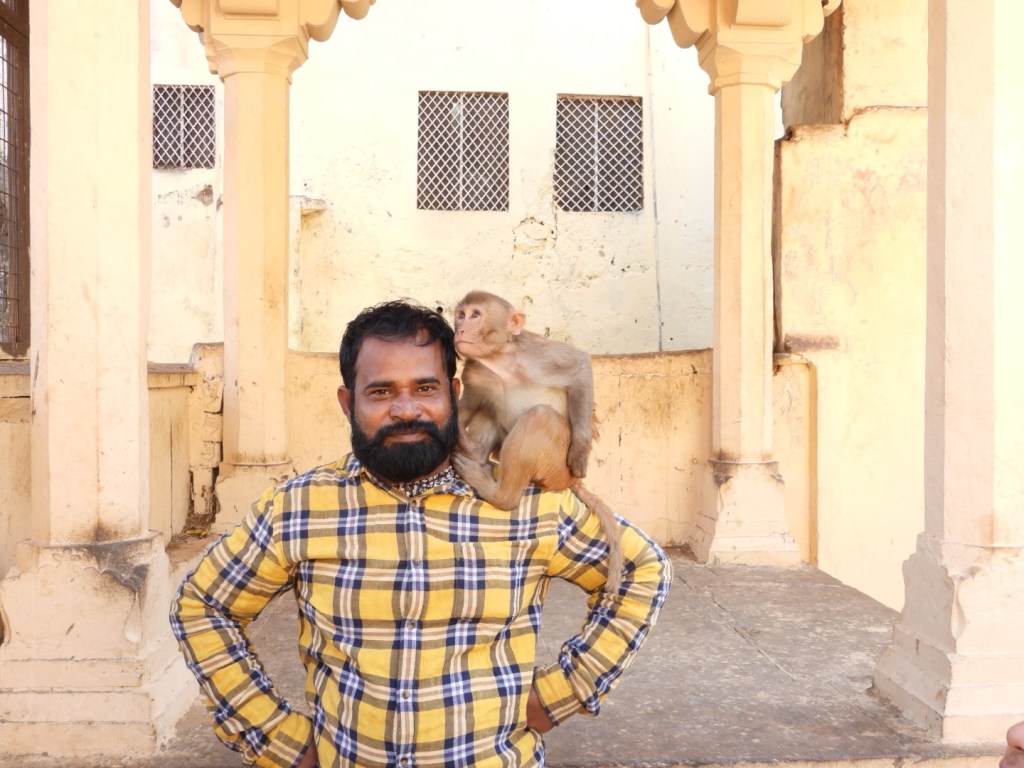
Dipesh, our guide, with a friend.
The place naming of Galtaji vs the ‘monkey temple’ reminds me of the ‘telephone game of tourism’ – a phenomenon where a place’s identity is slowly reshaped as information passes from one group to another—much like the game where a whispered secret becomes something entirely different by the end of the line.
In tourism, this happens through a cycle of mishearing, simplifying, and romanticising.
The Amber Palace was originally The Amer Fort, but which sounds more exotic and enticing?
Perhaps the weirdest part is when the locals start using the “wrong” name. When a community realises that tourists are looking for “Amber” and not “Amer,” they change their shop signs, maps, and tour scripts to match the tourist’s expectation. The “garbled message” at the end of the telephone line eventually becomes the new reality. A place has been renamed.
Why?

At this point we’d been in India about 10 days and I’d received several wildly different answers to “Why do Indians honk their vehicle horns so much?
This has sent me down a real rabbit hole, but I’ve come across at least five theories.
1. The “Sound Mirror”
Many drivers in India don’t use their side mirrors—sometimes they even fold them in to fit through tight gaps. Because they can’t see you, you have to make sure they hear you. Honking is just the way of saying, “I’m right behind you” or “I’m passing you now.”
2. The “Everyone is on the Road” Factor
Indian roads aren’t just for cars; they are shared by pedestrians, stray dogs, bicycles, and cows. Since there’s so much unpredictable movement, drivers honk constantly to create a “warning bubble” around themselves so nobody accidentally steps in front of them.
3. The “Magic Button” Habit
It’s a bit of a mind game. Drivers often honk at red lights or in a jam because, eventually, the traffic moves. Even though the horn didn’t actually cause the traffic to clear, the brain starts to think: “I honked, and then we moved, so honking works!”
4. It’s Just a Reflex
For most Indian drivers, honking isn’t a conscious choice—it’s like blinking. They’ve grown up in a noisy environment where the horn is just another part of driving. It’s rarely done out of anger; it’s just a muscle memory habit they don’t even notice they’re doing.
5. Claiming Your Space
In places where lane lines are ignored, the loudest person usually gets the right of way. By making a lot of noise, a driver is essentially shouting, “I’m taking this spot, so stay back!” It’s a way to claim a piece of the road when things get crowded.
A sixth theory came from one of our drivers. “Maybe we just have to be a little insane to drive on these roads in the first place?”
He said it, not me.
Four more tomorrow. (If you want more, and better photos – follow me on instagram)
Namaste!

 Paul Taylor
Leave a comment