
I took six weeks off work over the Christmas period, the longest period I’ve ever had off.
On my return, quite a few people asked me how many emails and messages I came back to. There were hundreds obviously. However, the thing that interested me the most was how few needed my attention.
Plenty wanted my attention, but hardly any needed it.
Less than ten, in fact.
The rest were all pretty much’work about work’. Things that I could , and perhaps should, give me attention to. But things that were not at all necessary in order for me to do my job role.
‘Work about work’ refers to the administrative and organisational activities that take up your time but do not directly relate to your job purpose.
Tasks that feel necessary but don’t actually produce anything new.
The term was coined at Asana by Dustin Moskovitz and Justin Rosenstein. They had noticed, whilst they were at Facebook, that as the company grew, they were spending more time in meetings, reading and composing emails, and updating spreadsheets.
The emerging work, co-ordination and communication, had taken over from the real work, coding and designing.
Being a productivity tool it’s clearly in Asana’s own interests to exaggerate the extent of problem – they report that up to 60% of our work time can be spent on relatively pointless tasks.
However, whilst critics have argued that this may be somewhat inflated (it’s all about the definition of what counts as ‘work’) nobody is denying the fact that this organisational drag is having a huge impact on productivity.
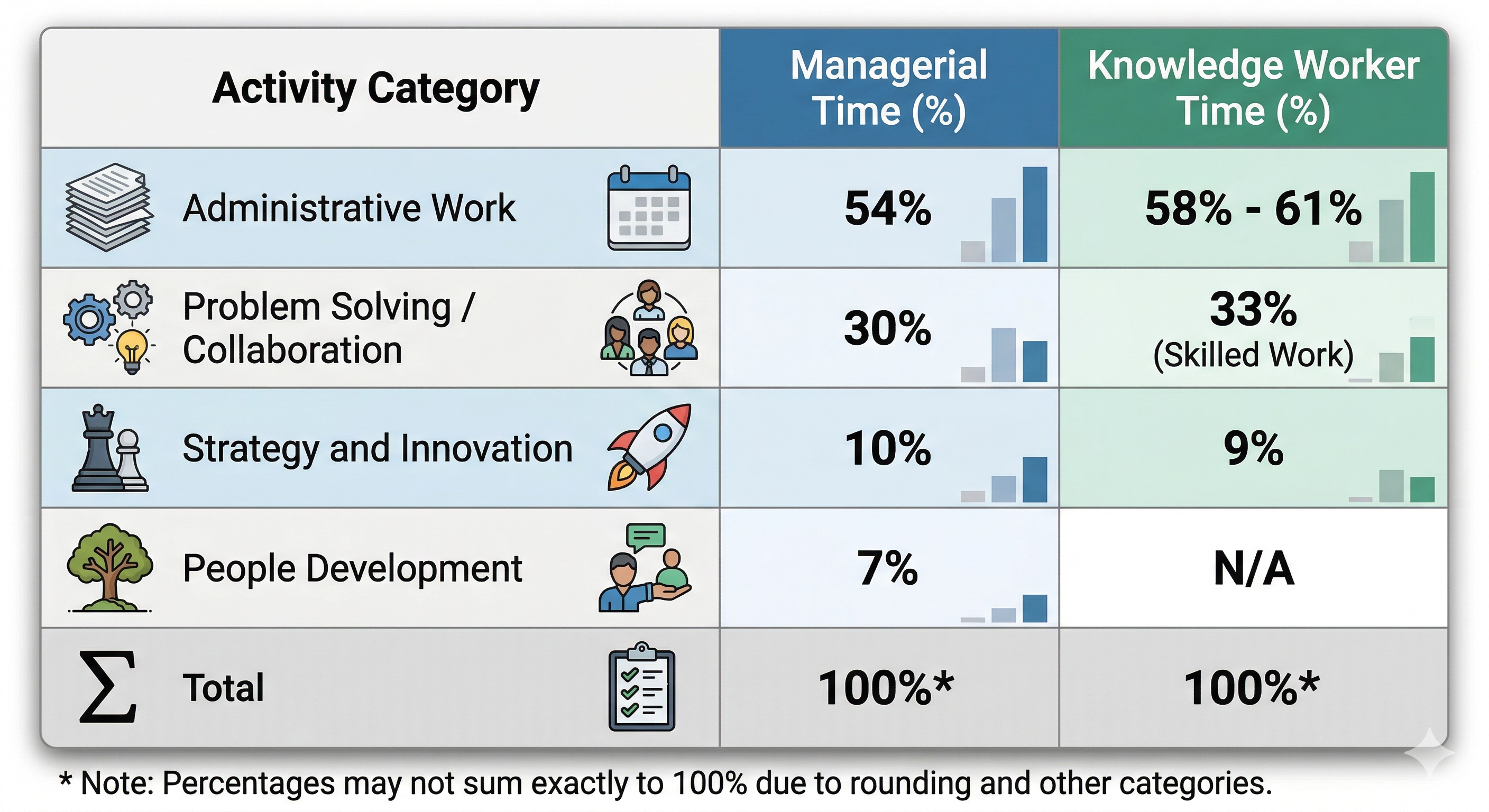
Workers report spending as little as 9% of their professional time on strategy and innovation, the very activities that are essential for the kind of radical change many of our organisations yearn for.
When only 48 minutes of a workday is dedicated to long-term thinking, the capacity for any radical reinvention effectively collapses.
But has it ever been any different?
The conventional view is that the array of digital tools at our disposal (or maybe it’s us humans at the disposal of the tools) has introduced profound distraction. 50% of workers say they experience ‘tool fatigue’.
The idea that constant distraction and fragmented attention are purely modern, digital-era phenomena is directly challenged by Henry Mintzberg’s 1973 study, The Nature of Managerial Work.
Through direct observation of executives long before the advent of email and smartphones, Mintzberg shattered the classical idea that managers were reflective, systematic planners who spent large blocks of time on strategy.
Instead, he found that managerial work has always been inherently characterised by brevity, variety, discontinuity, and an unrelenting pace.
Even in the early 1970s, without any bombardment of digital notifications, the median time an executive spent on any single issue was a mere nine minutes, with half of all activities completed in that timeframe and only 10% exceeding an hour.
Rather than contemplating long-term goals, he found managers were “slaves to the moment,” constantly shifting focus between disjointed conversations and having almost every action dogged by another diversion, interruption, or telephone call.
Distraction it seems, is a feature, not a bug, and has been part of management roles since the earliest research.
Little did Mintzberg know it was about to get worse. In the 1980s a new approach called New Public Management (NPM) changed how government worked by trying to run it more like a corporate business. The goal was to fix ‘slow’ government and public sector systems, but it did so by introducing more rules, constant tracking, and a heavy focus on data and numbers.
Now, instead of using their own professional judgment to solve problems, managers were stuck in a cycle of constant reporting. Arguably this was the real expansion period of ‘work about work’ where proving you did the work becomes more important than the work itself.
The ethos of NPM lives on to this day , despite overwhelming evidence of the shortcomings. In his excellent series on Substack Tim Brooks writes:
They (‘social purpose organisations’) have adopted a corporate style of ‘planning architecture’ for governance: long-term missions, interim milestones (KPIs), enabling foundations, and thematic pillars. What their service users need is to know when their bins will be collected, a leaky radiator fixed or help for a child in mental health crisis.
And this ‘planning architecture’ is arguably what has led to ‘work about work’ metastasising. Managers become so busy filling time with this rubbish that they don’t have the brain space or minutes in the day to come up with new ideas, or tackle complex social issues that span sectors.
Strategic thinking has been replaced by a heavy administrative burden that makes it almost impossible to imagine a different future, let alone create one.
So, what to do about it?
Clearly we need a radical organisational redesign that prioritises time spent on strategy and purpose over administration and counting. Many of us are attempting that journey.
These shifts take time though, so how can you at least stem the tide of work about work in the interim?
First, you can ruthlessly prune your calendar. Research shows that reducing meeting frequency by 40% can boost employee productivity by 71%.
You can defend ‘deep work’ and make organisational slack acceptable and intentional. Leaders must encourage time blocking and introduce intentional slack , the unscheduled time that gives people the mental bandwidth to think rather than just react.
And you can institutionalise innovation. As someone who has run an innovation lab I’m well aware of their limitations. But even a small function whose sole purpose is to research, prototype, and implement solutions at least provides you with some cover for strategy and innovation.
Most organisations claim to prioritise innovation, but the fact that only 48 minutes of a given workday is devoted to it tells its own story.
In sectors that are faced with increased demand, fewer resources and more complex issues, every extra minute spent on ‘work about work’ pushes you ever further away from what the users of your service really need.
Photo by Brian J. Tromp on Unsplash

 Paul Taylor
Leave a comment