Paul Taylor
-
Relationships aren’t very efficient, but efficiency isn’t always effective
“CEO-ification” refers to the trend of nonprofits and charities to increasingly mirror corporate and military structures. Often they will adopt similar language, hierarchies, and strategic approaches. The trend began in the late 20th century, with a significant acceleration in the… Continue reading

-
Should Organisations Sleep On Their Problems?
We know that sleep allows your brain to process information and consolidate memories. This can lead to new insights or perspectives on a problem when you wake up. Sleep helps regulate emotions and reduce stress levels. A calmer mind might… Continue reading

-
Combatting The Cobra Effect With Bottom-Up Planning
The Cobra Effect refers to a situation where an attempted solution to a problem actually makes the problem worse, as a result of unintended consequences. The term comes from a story during the British colonial rule of India. Concerned about… Continue reading

-
Institutional ‘Forgetting’ and The Failure of Corporate Memory
Corporate amnesia or ‘institutional forgetting’ -is a phenomenon where organisations lose valuable knowledge, experience, and insights over time. This can be a gradual process or a sudden occurrence, and it can have significant negative impacts on an organisation’s performance, decision-making,… Continue reading

-
Understanding Spreadability in Innovation
Guerrilla gardening, a movement born in New York City, spread globally as a way to reclaim neglected spaces. The movement gained momentum through word-of-mouth and grassroots activism. It emphasized clandestine planting and direct action. Will Lilley, from NHS England, highlighted… Continue reading

-
Net Zero and The Law of Horse Manure
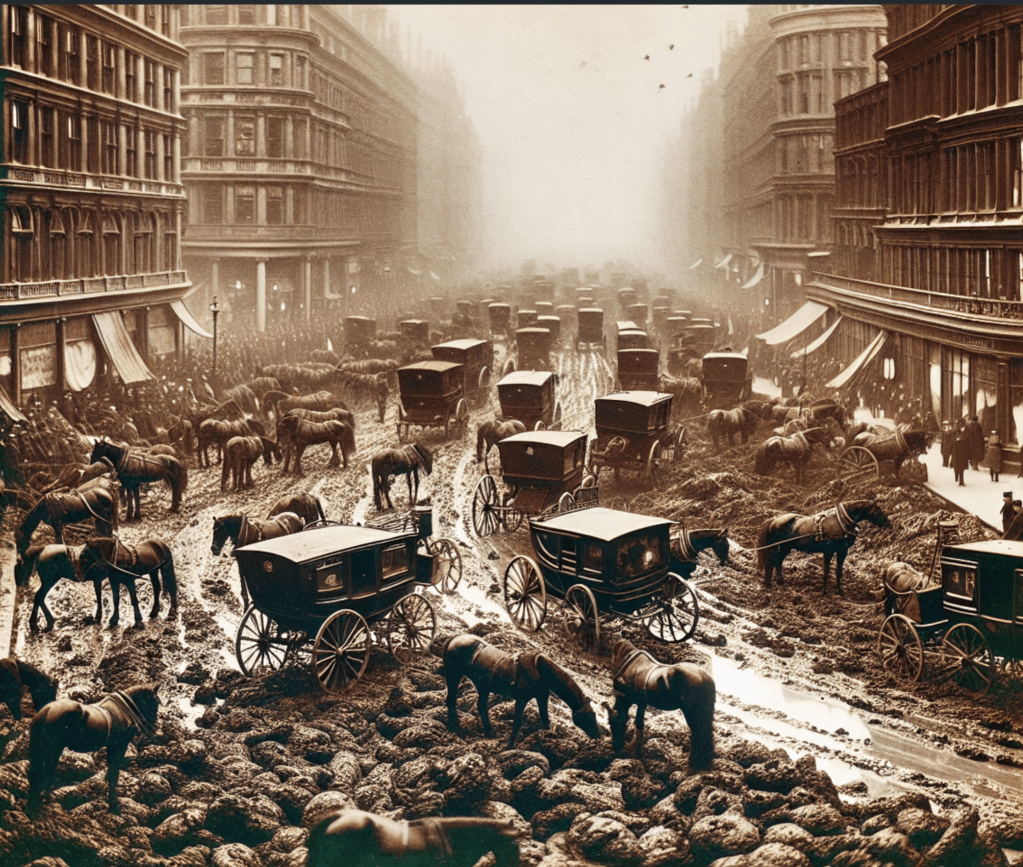
Catastrophic predictions that spell dark days for humanity are nothing new. The Times predicted in 1894 that in 50 years time, every street in London would be buried under nine feet of horse manure. It was the crisis of all… Continue reading
-
LinkedIn Vs Twitter: Which Is Best?
The older I have become the more I have realised that the best things that have happened in my life have had little to do with judgement, planning and forethought – and everything to do with random chance and connection.… Continue reading

-
Techno-admin, Microtransactions and Designing For Humanity
Techno-admin: a pervasive phenomenon, whereby we customers are forced into infuriating, confusing, absurdly time-consuming and bleakly unrewarding tasks by a machine We are all techno-administrators today. The average person has about 100 passwords to keep track of, a spiralling number of emails… Continue reading

-
The Law of Propinquity And The Work From Home Dilemma
In our post-internet, post-social media, post-covid world, does physical proximity still have value, particularly when it comes to creativity, innovation and discovery? The law of propinquity states that the greater physical (or psychological) proximity between people, the greater the chance that they… Continue reading

-
The Growing Bureaucratisation Of Life
Many organisations , without realising it , act as inhibitors of creativity. Rules and protocols are put in place – often for very good reasons – that preserve the status quo. Over time, organisations develop a set of social norms – ‘the way we… Continue reading

-
Are You A Positive Deviant, A Negative Deviant, Or Just Plain Boring?
Even if your customer satisfaction scores are upper quartile. Even if you’re a favourite with your regulator. A crisis can be waiting around the corner for any organisation. You can’t regulate a toxic culture and you don’t build trust with… Continue reading

-
Fix The System Problem, Not The People Problem
The phrase ‘shuffling deck chairs on the Titanic’ is believed to have been first used in 1969. It featured in a Time Magazine article that quoted a priest decrying petty internal changes at a time when the Catholic church should… Continue reading

-
Designing For Connection Rather Than Transaction
Health is not made in health systems, it’s made in homes, in communities, in workplaces. So unless we can build horizontal bonds between communities and the kind of expertise and resource in health systems, we can’t really make change. Hilary… Continue reading
-
The Importance of Connectors
“The point about connectors is that by having a foot in so many different worlds, they have the effect of bringing them all together.” ― Malcolm Gladwell If you want to change something or spread ideas you need to mobilise people… Continue reading

-
We Should All Delete More Work
At my organisation, during a cyber incident which meant no access to any computer system for several weeks, some teams reported becoming more effective not less. Many other people noticed this at the beginning of the 2020 lockdowns. Deprived of… Continue reading

-
Efficiency Isn’t Always Effective
Being efficient is not half as effective as conventional management would like to think. Working across health, the criminal justice system, mental health, housing, social care, or education requires us to take a whole person view of someone. It requires… Continue reading

-
How To Behave In A Legacy Organisation
“I was a Legacy manager in a Legacy organisation. We were mainly caretaking a broken model, trying to make it function better.” Kate Davies It’s always refreshing to hear a CEO, or ex-CEO, offer a pragmatic take on their career… Continue reading

-
The Inauthentic Authenticity of LinkedIn
Amidst all the talk about about the chaos/decline of the network formerly known as Twitter, hardly anyone is talking about what is happening on LinkedIn. LinkedIn is the world’s top professional social platform, with over 930 million members from 200… Continue reading

-
The Abilene Paradox And The Dangers of Assuming People Agree With You
The Abilene Paradox is a situation in which a group makes a decision that is contrary to the desires of the group’s members, because each member assumes the others approve of it. It’s titled after an example used by Jerry… Continue reading

-
The Gravitational Pull Of Business As Usual
The interior secrets of black holes are guarded by a one-way light-trapping boundary called the event horizon. This horizon is the point, according to NASA, that the gravitational influence of the black hole becomes so intense that not even light… Continue reading