
I didn’t know quite what to expect at Agile on the Beach – a conference that’s more like a festival with a beach party attached.
How do you talk about place-based work with an exclusively tech crowd?
Actually, it’s easy, as the principles of place-based work ARE agile. Or at least agile lite as I refer to it.
Our session was a bit of moonshot – what if agile places could save the public sector?
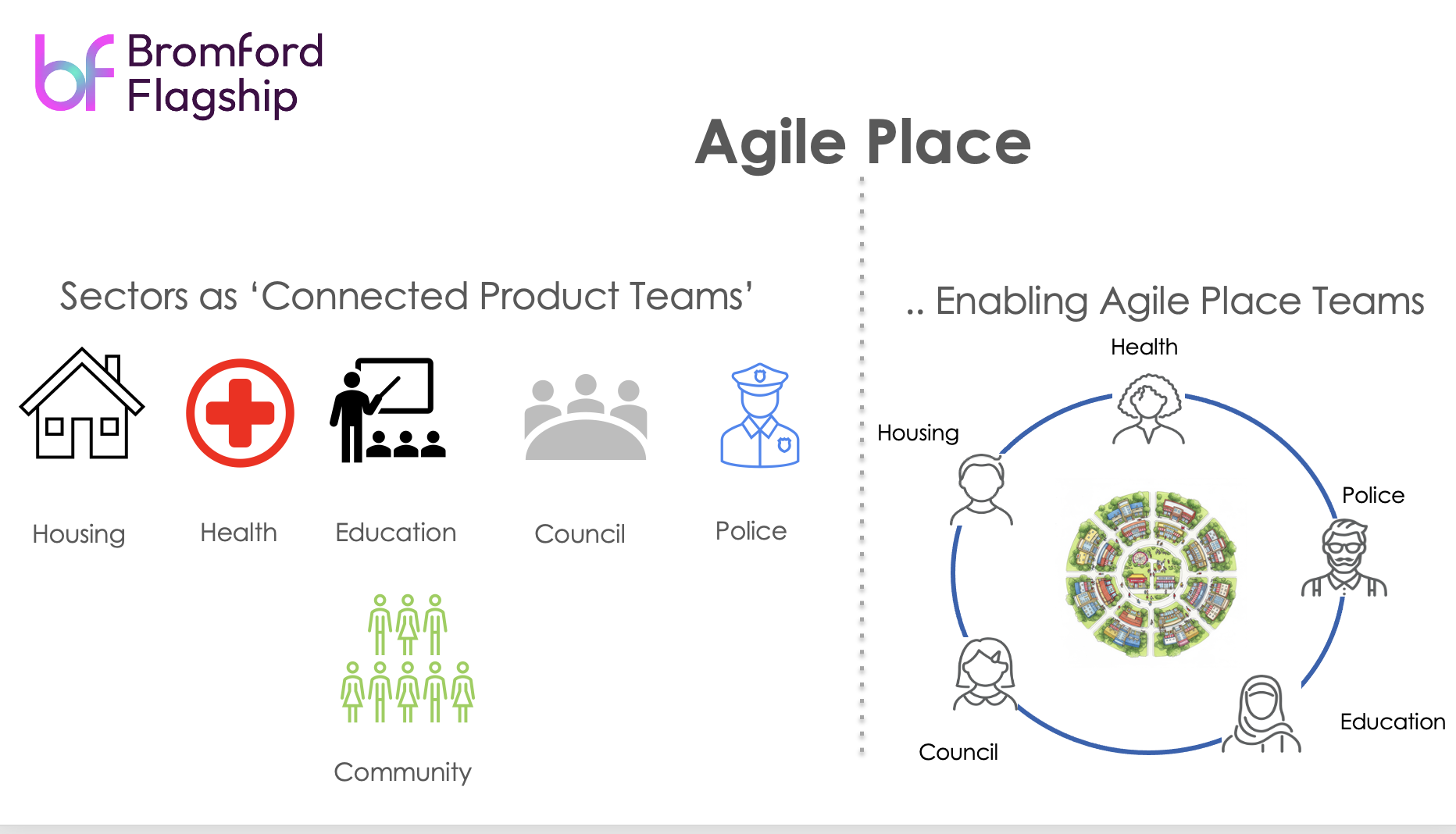
What if we stopped thinking of individual sectors and started thinking about of them as ‘products’ that require interoperability? For one, we’d have the money and resources to do things that are simply impossible at the moment.
I enjoyed many of the talks at but probably the one that struck me the most was the call to arms from Rob Macadam from the NHS. He asked what’s the alternative to bottom up agility? More top down? More attrition? His call for a movement is very much in tune with our thinking: the present model is busted – we need to re-imagine it.
For too long, the public sector has been riddled with legacy practices that have inadvertently (or sometimes, quite deliberately) built disconnected empires. These are systems that often prioritise senior management directives, reinforce rigid hierarchies, and frankly, hoard power.
Each sector, be it health, housing, social care or education are crying out for more more investment. Yet, in a country that pays £100 billion just to serve the interest on its debts, that money is not coming.
We are at the beginnings of a counter-movement: embracing agile lite place focused practices. This isn’t just about buzzwords; it’s about fundamentally reshaping how government operates, by treating ‘sectors as products’ and requiring them to actually connect for the good of citizens.
From Bureaucracy to Citizen-Centric Products
Grand, sprawling projects, conceived in isolation, taking years to deliver. By the time they launched, they are often obsolete, riddled with costly overruns, and utterly disconnected from the real needs of the people they were meant to help. Because the focus was always on the project itself, the budget, the timeline – not the needs of actual human beings.
An ‘agile place’ view demands a radical shift. It pushes us to view public services – be it healthcare, education, or social support – as evolving products. This means:
Continuous Value, Not Deadlines: The goal isn’t just to finish a project, but to constantly deliver and refine something valuable. This strips away the excuses for endless delays and forces a focus on tangible impact.
Users, Not Committees: Agile place demands relentless focus on the citizen as the ultimate user. This should cut through the layers of internal committees and political agendas, forcing services to be designed with real people in mind, gathering constant feedback to ensure relevance.
Dismantling “Because We Always Have”: Product thinking challenges the inertia that protects outdated systems. If a product isn’t delivering value, it must change or even be retired, regardless of whose empire it belongs to.
Connecting What Was Deliberately Disconnected
Perhaps the most insidious outcome of legacy practices is the creation of siloed institutions, each guarding its turf, its budget, and its data. Agile place directly confronts this:
Small, Empowered Teams Over Siloed Giants: Agile place thrives on cross-functional teams – small, nimble groups with diverse skills. Imagine health, housing, and benefits teams truly collaborating from day one, rather than tossing problems over the wall. This breaks down fiefdoms and replaces them with shared local purpose.
Community Is The Optimal Unit For Change: Agile place is easier to change as it is focused on a smaller population. Here, local optimism and the tangible nature of local problems make them more solvable. Communities possess unique local knowledge and are agile enough to adapt quickly.
Adapt or Die, No More Excuses: The public sector often moves at a glacial pace, citing ‘complexity’ or a lack of resource as an excuse for inaction. The core strength agile place is its adaptability and deeper lens. Working at place level means services can respond quickly to new societal shifts, or crises. No more hiding behind rigid, years-old plans while citizens suffer from outdated systems.
Transparency as a Weapon Against Obscurity: Agile place champions radical transparency – visible progress, open communication, and shared understanding. This directly challenges the opacity that allows mismanagement, budget bloat, and power hoarding to flourish within disconnected departments.
Learning, Not Blame: Instead of endless post-mortems assigning blame, agile place fosters a culture of continuous improvement through learning. Regular ‘retrospectives’ encourage teams to honestly assess what’s working and what’s not, allowing for rapid course correction without the typical fear of reprisal that stifles innovation in rigid hierarchies.
By embracing ‘sectors as products’ and applying agile place practices, we’re not just talking about minor improvements or efficiency.
It’s about shifting power back to where it belongs: with the citizens and places these services are meant to serve. It’s about dismantling the ‘deliberately disconnected empires’ and building something truly effective, preemptive, and humane.


 Paul Taylor
Leave a reply to The Problem with a Narrow Focus on Efficiency – Paul Taylor Cancel reply