
“I was a Legacy manager in a Legacy organisation. We were mainly caretaking a broken model, trying to make it function better.”
Kate Davies
It’s always refreshing to hear a CEO, or ex-CEO, offer a pragmatic take on their career accomplishments. As I’ve said before there’s a fairly repeatable pattern in the behaviour of senior leaders when they move on or start a consultancy. They will often become more outspoken about the failings of the system they were part of and become more self critical.
It can often be dismissed by the next generation of leaders – who are completely convinced they can change the world in a way their elders could not.
If you’ve worked in any industry for more than 15 years you will know this simply will not happen. Successive generations fail to learn the lessons of the past – as there is rarely an organisational memory of what worked or failed. It’s the system that needs changing, not the people.
It becomes a doom-loop. Tinkering about with a busted model using new tools. “A.I will solve it” being the latest one.
It’s important to remember that in many cases disruption doesn’t happen from one day to the next, it’s not a big bang. Disruption to many industries is often a gradual process over a number of years
Stasis. Followed by irrelevance. Followed by excruciating, painful decline. Followed by death.
So, before we consider what a legacy organisation should do, let’s define what one is.
A legacy organisation is defined as one where all processes, technology and ways of working where in place before the modern internet. The web opened to the public in 1991 and began to enter general use in 1993–4. So if your organisation was founded before 1990, you’re working in a legacy organisation. As Mark Thompson described, that’s:
- 430+ Local Authorities
- 168,000 Charities
- 650 NHS trusts
- 43 Police Forces
- 143 Universities
- 1500 social housing providers
All legacy. So what to do?
The mistake many organisations make when trying to change a legacy model is to try to behave like a startup.
- You try to adopt agile methodologies and talk as if they work at Spotify
- You bring someone in to give an “inspirational talk” on innovation
- You hold a one-day workshop to get your company to be more creative
- You get a cool space with loads of beanbags and motivational posters
- You have a hack day
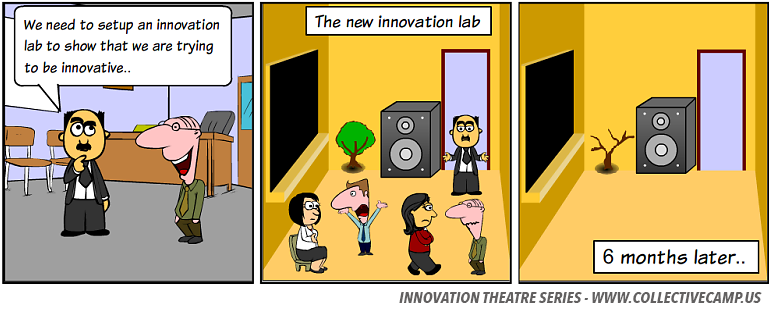
That’s not innovation. That’s what Steve Blank termed innovation theatre. Just for show, with no real outcome.
A legacy business has to recognise that it cannot innovate using the tactics of a startup – as it isn’t a startup.
Startups are not smaller versions of established companies in the same way as children aren’t smaller versions of adults. As Steve has written “companies looking to be innovative face a conundrum: Every policy and procedure that makes them efficient execution machines stifles innovation.”
Once you have KPIs in place, your organisation has decided on a repeatable business model – and innovation takes a backseat.
“Paradoxically, these very KPIs and processes, which make companies efficient, are the root cause of corporations’ inability to be agile, responsive innovators.“
So, strategically, the only way out of your own legacy is to recognise that you ARE a legacy organisation and to build on your strengths and nullify your weaknesses.
Legacy organisations have some advantages. As Kris Østergaard says “Legacy organisations have money, they have customers, they have data, they have infrastructure, they have suppliers. Startups have almost none of this.”
Amazon is 29 years old, so just avoids being included in our definition of a legacy business. They have attempted to stave off stasis through adopting a “Day One” mentality – the company treats every day like it’s the first day of their new startup.
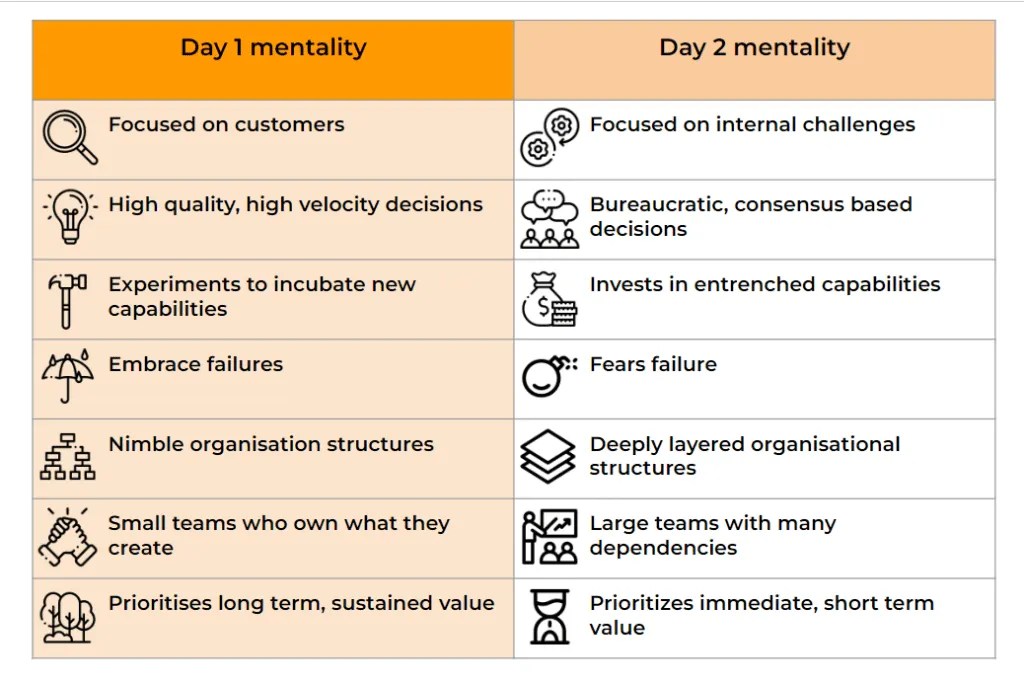
I’d argue though that a true legacy organisation couldn’t adopt a Day One mentality, the barriers are simply too ingrained. Never mind Day Two – It’s nearer to Day Twenty Thousand.
The company I work for is 60 years old this year, with the first recorded meeting taking place on 21st November 1963. Bromford is not only pre-modern internet, it is pre-colour television.
The only real way for a legacy organisation to avert stasis is to remain curious and continually question what you think you know.
As Bromford Lab said a few years ago before a round of discovery sessions:
“Most organisations in a sector operate in exactly the same way, and that’s led to generations of people all thinking that the formula must be the right one and can’t be changed.“
Elon Musk popularised the idea of first principles thinking. This is basically the practice of actively questioning every assumption you think you ‘know’ about a given problem or scenario — and then creating new knowledge and solutions from scratch“
Five years later, Bromford are in another cycle of ‘discovery’ that will span the first year of a new strategy.
Year One: Be curious
Year Two: Experiment
Year Three: Execute
Year Four: Embed

Year 5: Repeat?
Legacy organisations can never behave like startups. They can though be as curious as startups are, by constant questioning of what they think they know and phases of deliberate experimentation before making any plans.
Stasis. Followed by irrelevance. Followed by excruciating, painful decline. Followed by death.
The only way to avoid stasis for a legacy organisation is for your strategy and culture to never stay still.
Photo by Justin Heap on Unsplash


 Paul Taylor
Leave a reply to Institutional ‘Forgetting’ and The Failure of Corporate Memory – Paul Taylor Cancel reply