
In 2017 the charity, Comic Relief, broadcast an appeal featuring Ed Sheeran offering to personally pay for a hotel to house street children in Liberia.
What Comic Relief saw as a heartwarming act of generosity, was quickly blasted as exploitative, even winning an award for being the most offensive fundraising campaign of the year.
“This is a video is about Ed Sheeran,” the award organisers said in their commentary. “It’s literally poverty tourism. The video should be less about Ed shouldering the burden alone but rather appealing to the wider world to step in. Is Ed Sheeran willing to pay for the boy’s housing forever?”
This infamous moment was manifestation of ‘Organisational Main Character Syndrome’. Instead of acting as a collaborative partner, Comic Relief adopted the persona of a singular hero, using Africa as a mere cinematic backdrop for a privileged celebrity to swoop in and play the saviour.
The concept of Main Character Syndrome first emerged in internet culture, initially on TikTok, during the COVID-19 pandemic.
Deprived of social contact people began romanticising their lives online, filming themselves fulfilling mundane tasks as though all eyes should be on them. People would cast themselves as the main character: a hero (or sometimes a victim) in their own personal drama.
Those with Main Character Syndrome see themselves as the ones driving the story or game, whilst the rest us are the non-player characters (NPCs), who exist to populate their world and give them what they crave the most: attention.
The concept and behaviour of main character syndrome quickly spread to other social networks and is now visible almost everywhere (hello, LinkedIn!)
Can Main Character Syndrome Affect Our Organisations and Institutions?
I think there is a read across from individual attention seeking to how organisations such as Comic Relief and other non-profits can behave.
Organisational Main Character Syndrome (OMCS) is when an institution stops viewing itself as a collaborative partner in a wider ecosystem and instead adopts the persona of a singular hero with a unique purpose.
The organisation can quickly begin to overestimate its own importance, talking about its own vision, its own impact, the awards it has won. It can begin to frame complex systemic issues (e.g homelessness) as simple rescue missions (look how happy we have made this family who we just housed).
Instead of enabling communities or shining the light on individuals, the organisation swoops in to save them with a self-aggrandising narrative.
Here are some of the typical behaviours and traits of ‘Organisational Main Character Syndrome’
1. Centralised Control
The system behaves as the hero of the story, making all the big decisions from a central headquarters. It assumes that wisdom sits at the top and filters down, often ignoring the side characters (residents and local frontline staff) who actually live and breathe the reality.
2. Service Siloing
It organises the world into neat, separate boxes. It doesn’t see a person; it sees a patient, a mental health case, a housing applicant, a jobseeker. Because the system is the protagonist, it expects people to navigate its complex rules, rather than the system adapting to the person’s life.
3. Passive Engagement
In this mindset, the system treats its users as passive clients. It behaves as the provider and expects the public to be grateful recipients or beneficiaries. It rarely asks people to contribute their own assets or ideas, fearing that doing so might relinquish its control over the narrative.
4. Risk Aversion and Compliance
The system is obsessed with hard data points and short-term linear outcomes. Its primary motivation is often avoiding a bad review from regulators. This leads to defensive behaviours, where following the correct procedure becomes more important than actually solving a persons problem.
5. Standardisation Over Localisation
The Main Character System values consistency above all else. It tries to apply the same solution to every neighbourhood, regardless of unique local needs.
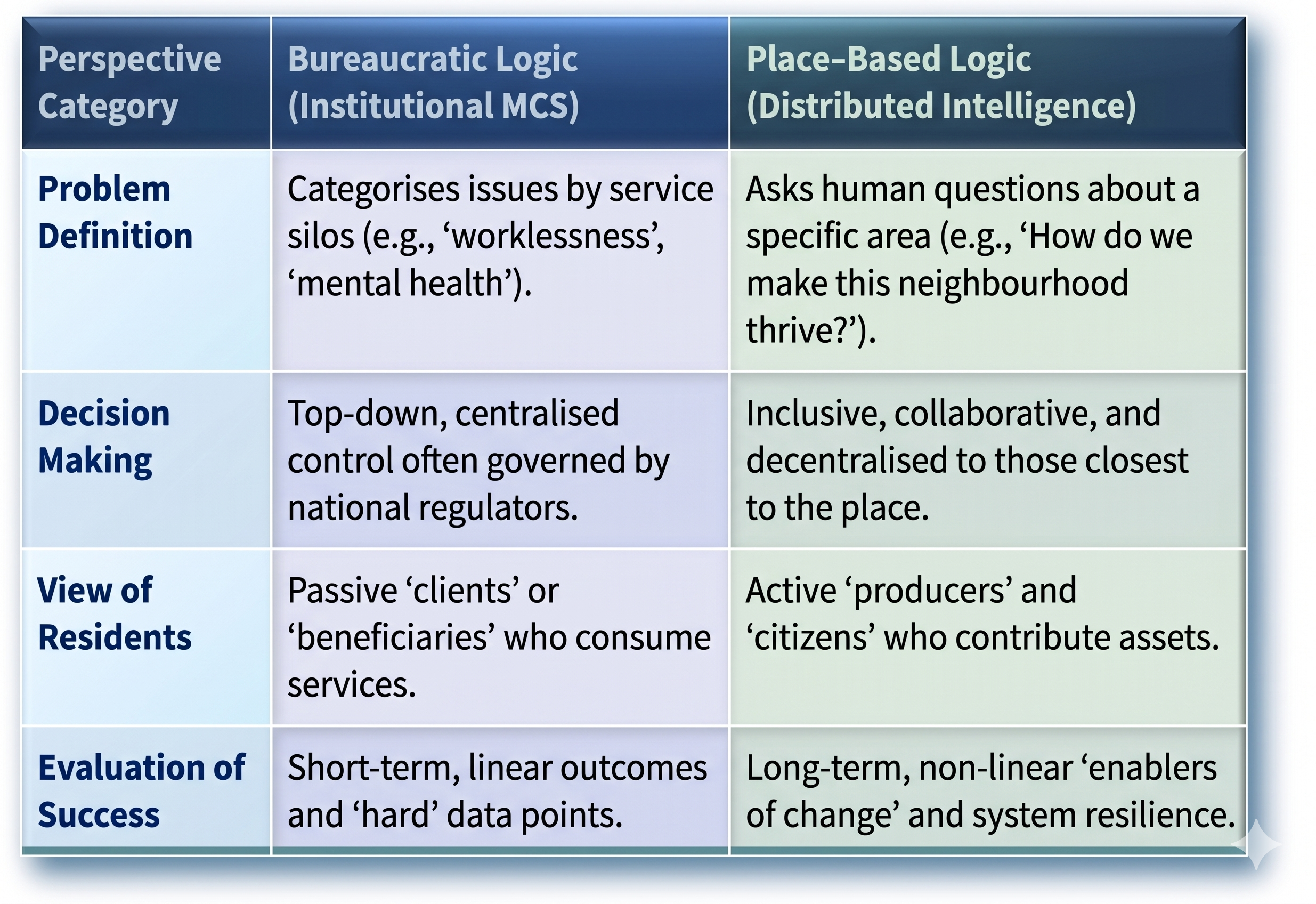
Organisations Stepping Out of the Spotlight
If an organisation wants to cure its Main Character Syndrome, it needs to step out of the spotlight and start seeing the world from a different viewpoint. It needs to view people and places as the most effective unit of change , not itself.
Shifting from Deficits to Assets (ABCD) Organisations must move away from their bureaucratic logic of mapping a community’s deficits (poverty, crime, debt) and start mapping what is strong, not what is wrong. An organisation should only intervene where the community absolutely needs outside help, moving from a model of doing to or doing for a community, to doing by or with the community.
Decentralise the Storytelling If you want to tell authentic stories, you must pass control of the narrative to the people actually living those stories. The person who had the experience is the most legitimate interpreter of its meaning and effect.
Embrace Place-Based Working Place-based working acknowledges a radical truth: that place exists independently of your organisation. Rather than viewing residents as passive consumers of your services, treat them as active citizens and producers. Place-based partnerships require organisations to share resources, pool knowledge, and act as collaborative partners in an ecosystem, rather than top-down directors.
The antidote to a toxic main character complex requires stepping out of the spotlight and decentralising the narrative.
Following the intense public backlash to Ed Sheeran gifting hotel stays, Comic Relief radically changed its approach. It dropped its outdated white saviour formula and instead recruited local African filmmakers and photographers to direct their appeals. By stepping back and letting local heroes speak in the first person, the charity finally gave agency, dignity, and a platform back to the people.
Avoiding organisational main character syndrome means dropping the hero act.
To truly enable a community to step forward, an organisation must be willing to become a minor character in the main story.


Leave a Reply