
A mechanical ratchet only turns in one direction; it physically prevents backward motion. In public service design, the bureaucratic ratchet operates on the exact same principle: it ensures that when a centralised system begins to fail, the organisational response is never to reduce complexity or restore local autonomy.
The response is always to add more process.
I’m writing this on the way back from Disruptive Innovators Network annual customer experience conference. Alongside Kelly Webster, I presented on a topic that challenges the fundamental operating logic of the social housing sector where the prevailing model—one built on mass centralisation and mass compliance—is fundamentally broken.
For the last two decades, public services and housing providers have worshipped at the altar of economies of scale. The theory dictated that if we pulled our teams out of local communities and pooled them into highly centralised hubs, we would become more efficient.
In reality, centralisation stripped out local context.
We built massive contact centres to manage customer friction, and when those systems generated overwhelming failure demand, we didn’t fix the underlying service. Instead, we fell victim to the bureaucratic ratchet. We created a culture of mass compliance, focusing heavily on what is immediate rather than what is genuinely important, and responding to the rules of the game rather than actively influencing or changing them.
We treated the symptom (high volumes of customer contact) while entirely ignoring the disease: a fragmented, disconnected operating model.
The Trap of the Bureaucratic Ratchet
When a centralised contact centre inevitably begins drowning in failure demand, the system panics. But rather than interrogating the broken service delivery that caused the phone to ring in the first place, management tightens the ratchet to regain a sense of control.
This plays out in a predictable, escalating cycle:
The Scripting Click: When remote agents struggle to resolve complex, hyper-local issues they have no context for, the organisation introduces rigid call scripts to standardise the un-standardisable. Discretion is stripped from the frontline.
The Triage Click: When the scripts fail and wait times soar, the organisation creates a new layer of triage agents. Their only job is to categorise the citizen’s distress and place them in a secondary queue for a specialist, turning one contact into three separate tickets.
The Assurance Click: To manage this new complexity, quality assurance and compliance teams are hired to monitor whether the triage teams are following the scripts correctly.
The Complaints Click: Frustrated by the friction, residents bypass the standard process and file formal grievances. The organisation responds by building a massive secondary bureaucracy, a complaints team, whose entire job is to manage, log, and apologise for the fact that the original service didn’t work.
With every click of the ratchet, the distance between the citizen’s problem and the person actually authorised to solve it grows wider. The system becomes a fortress defending the back office from the public. We mistake mass compliance for good governance, locking in a bloated machine entirely disconnected from the reality of the place it supposedly serves.
Flipping the Model: The Centre as a Platform
Breaking the bureaucratic ratchet requires more than tweaking a few processes; it demands a radical redesign of how we operate. At Bromford Flagship LiveWest (BFL), we have embarked on a long-term commitment to become a place-based organisation at scale, stretching our strategy from 2026 all the way to 2041.
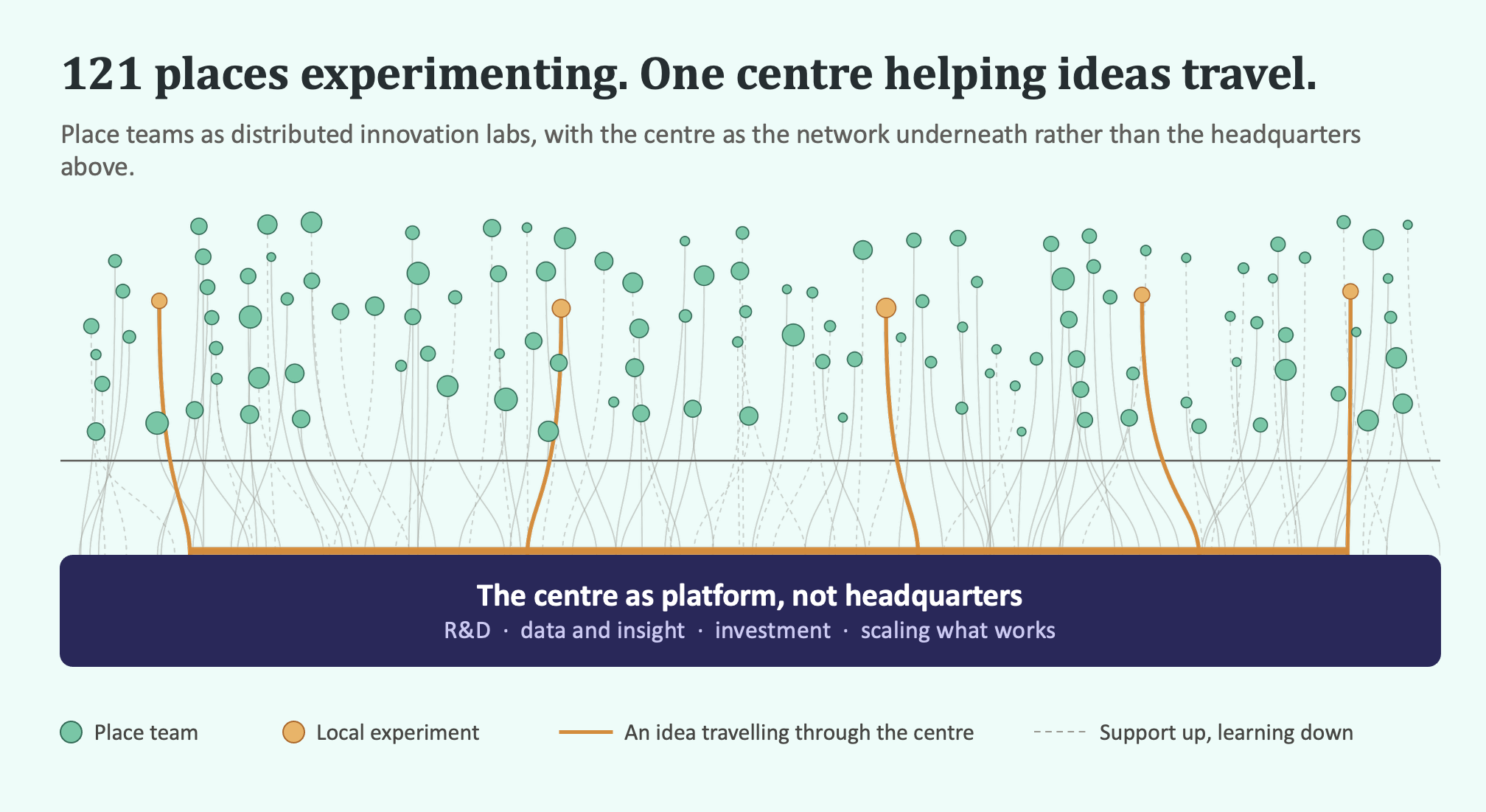
The core of this shift is moving away from a focus on siloed functions to a relentless focus on Place. To do this, we had to rethink the role of the corporate headquarters. In a place-based model, we view the centre of the organisation as a platform, not a headquarters. Instead of a top-down authority dictating local actions, the centre acts as the network underneath, providing R&D, data insight, and investment to support local experimentation and scale what actually works. 100+ micro teams free to experiment with support from the centre.
Designing for the Local
When you push autonomy back out closest to the customer, services fundamentally change. Instead of forcing customers to navigate a complex web of isolated departments, we begin to build local, consistent, and multifunctional teams.
Crucially, this model elevates the voices of those closest to the work. We have found that unsung roles like cleaners and caretakers are making a massive difference; they are often the colleagues who know the residents and the physical environment better than anyone else. Because the team understands the hyper-local context, problems are caught early. Enabling teams can spot a health and safety issue or a damp problem on an estate and resolve it before it ever has the chance to trigger the bureaucratic ratchet of a formal complaint.
We are moving away from transactional encounters toward relationships that feel real, trusted, and valued.
Mass centralisation promised us a streamlined future, but it delivered a system devoid of context and empathy. The shift to Place ensures that we stop managing failure demand from afar and start solving problems at the source.


Leave a Reply